Wednesday, August 28, 2013

4 Months of Waiting

In my opinion, infertility breeds self-centeredness. Part of the grief is asking "Why me?", and it is easy to get fixated on that. I don't blame anyone in that spot for having that reaction, but it can be very exhausting.

I enjoy different perspectives. My career requires empathy, so it is something I practice regularly and probably already have a predisposition to. I had the pleasure of meeting Jody Cantrell Dyer, author of "The Eye of Adoption" (which happens to be an interesting, funny, and easy read!) In her discussions of her book, she addressed birthparent grief in a way I hadn't exactly thought of. Yes, I already believed it is with great grief (and determination and love) a birthparent makes an adoption plan. I can only imagine the gut wrenching tears when looking at profile books or giving birth or going home empty handed.

Jody talked about the open adoption of her son and her relationship with the birthmother. In the book Jody shares a letter she (Jody) wrote to the unborn child during the adoption process. In part:
          "Maybe God is letting me suffer so I will be able to empathize with your birthmother".

In the discussion, she expanded on concept. A prospective adoptive parent may have mixed emotions when seeing pregnant folks or going to showers or being asked questions about the process. However, it is a hidden pain for the most part. No one wears a sign that says "I can't have a baby, and now I have to wait to adopt". Ones close to the prospective adoptive parents may know the struggles, but is not on display.

A prospective birth parent (or expectant parent) probably has those same emotions when seeing pregnant folks or going to showers; for them, this is a constant reminder of their pain, as it is for a prospective adoptive parent. However, as their stomach grows, they have constant questions. "When are you due? What are you having?" Constant reminders of what could be but realistically can't be what they wish it to be. Many people, both loved ones and strangers, judge birth parents. "How can you just "give them away"? If you really loved them, you would make it work!"

I can't imagine that seething judgement. That is much worse than my pain. I am empty handed right now, but in the end, eventually, I will have a child to love and parent and watch grow. I can cook them breakfast every morning and kiss them goodnight every evening. A birthmother will have pictures or letters or occasional visits. That idea is not lost on me.

Waiting is hard, but I will try to learn what I can. If a greater empathy is one thing I can take away, I want to accept that. I pray for our future child's birthmother (and birth family). Wherever they are, and whatever part of the process they are in now, I want them to have comfort and peace.


Monday, August 26, 2013

Today


From earlier tonight: Having a very pleasant dinner on the patio of a local burrito place! It's hard not to get frustrated and down with the adoption process but one day I will want a peaceful evening with guacamole, a cool breeze, Jack Johnson, and a sunset so I'm going to enjoy today.

Sunday, August 25, 2013

Saturday, August 17, 2013

Update on Baby Veronica

 From CBS on 8/14/13

A South Carolina couple seeking to adopt a young Cherokee girl took their fight to Oklahoma on Wednesday, hoping to visit the child who previously lived with them for 27 months and seek a compromise with her biological family that would return Veronica to their home.


Matt and Melanie Capobianco believe they have done everything necessary to regain custody of the girl, who is about to turn 4. The U.S. Supreme Court said in June that provisions of the Indian Child Welfare Act, which would favor the girl's father, didn't apply in the case, and a South Carolina court awarded the couple custody on July 31.

The ongoing dispute has raised questions about jurisdictions, tribal sovereignty and the federal law meant to help keep Native American tribes together.

"We made the trip to Oklahoma to get our daughter," Matt Capobianco said at a news conference in downtown Tulsa on Wednesday. "Veronica will be coming home, but if there is going to be some thoughtful solution that continues to involve all who love her, then this is the time."
The girl, under a Cherokee Nation court order, has been with the family of Dusten Brown, her biological father. The tribe's chief urged patience.

"The Capobiancos have requested the Cherokee Nation and Dusten Brown to follow the South Carolina court's order, but they forget that Dusten Brown has the same rights to have his arguments heard before our Oklahoma courts and Cherokee Nation Tribal Court," Chief Bill John Baker said. "The Cherokee people throughout time have stood our ground and for the rights of our people, and this is no different. We will continue to stand by Dusten and his biological daughter, Veronica, and for what is right."

Oklahoma Gov. Mary Fallin urged the families to get together and talk — even threatening Brown with extradition to South Carolina on a charge of custodial interference if he was "unwilling to cooperate."

Veronica was born in late 2009. Brown initially did not press his parental rights — the girl's mother is not Native American — but when he discovered Veronica was going to be adopted, he objected and said the ICWA favored the girl living with him and growing up learning tribal traditions.
The Capobiancos and their supporters said Wednesday a compromise is in order.

"We don't seek victory. What we seek is peace for our daughter," Melanie Capobianco said.
Troy Dunn, a family representative, said he was willing to meet with Brown to discuss arrangements.
"Only one side has been deemed the rightful parents," Troy Dunn said at the family's news conference. "Possession is not nine-tenths of the law."

A handful of protesters shouted "Keep Veronica home" and "You're trying to break laws in Oklahoma" at the Capobiancos as they emerged from a hotel after meeting with reporters. Some held signs reading "Keep Veronica Home" and others that were written in the Cherokee language.
Under the Indian Child Welfare Act, the Cherokee Nation has a vested interest in the child and, if invoked at the right time, the law allows the tribe to take over the adoption proceedings. In June, the U.S. Supreme Court ruled that South Carolina courts should decide who gets to adopt Veronica, rejecting earlier decisions in South Carolina that said the federal Indian Child Welfare Act favored her father.

South Carolina Gov. Nikki Haley has written to Oklahoma Gov. Mary Fallin seeking Brown's extradition after he was charged with custodial interference after missing a court hearing this month. Fallin initially said she would consider the warrant next month, after Brown's expected Oklahoma court appearance, but on Wednesday she tried to use the extradition papers as leverage in an effort to get the families talking.

A first step would appear to be setting up a meeting between the Capobiancos and Veronica.
"Mr. and Mrs. Capobianco deserve an opportunity to meet with their adopted daughter. They also deserve the chance to meet with Mr. Brown and put an end to this conflict," Fallin said.
The Oklahoma governor urged a quick resolution and said, "If Mr. Brown is unwilling to cooperate with these reasonable expectations, then I will be forced to expedite his extradition request and let the issue be settled in court."

Fallin did not set a deadline. The Capobiancos said they didn't know how long they planned to stay in Oklahoma.

Dunn said he would meet with Brown anywhere, anytime to develop a plan to raise the child.
"There is but one solution which takes Veronica's short-term and long-term needs into account: compromise," Dunn said.

"Lord, I Need You"


Friday, August 16, 2013

Wednesday, August 14, 2013

Psalm 13


1How long, Lord? Will you forget me forever?
    How long will you hide your face from me?
How long must I wrestle with my thoughts
    and day after day have sorrow in my heart?
    How long will my enemy triumph over me?
Look on me and answer, Lord my God.
    Give light to my eyes, or I will sleep in death,
and my enemy will say, “I have overcome him,”
    and my foes will rejoice when I fall.
But I trust in your unfailing love;
    my heart rejoices in your salvation.
I will sing the Lord’s praise,
    for he has been good to me.
-Psalm 13

Saturday, August 3, 2013

Genes, Mental Illness, & Adoption

Under normal circumstances, once one conceives a child, they pray for 9 months that the child is healthy and happy. There are no guarantees in life, but there is a definitive time frame for resolution (once you're pregnant... there's no going back) and fewer choices (usually you combine your and your partner's genetics and what happens, happens).

In adoption, you open yourself up to so much uncertainty. You have to make so many decisions. It's both an emotional and logical process to decide what situations you are comfortable with and how to proceed: what type of adoption? race? family history of mental illness, medical conditions, or intellectual disabilities? STDs in expectant mom? criminal history in family? conception through traumatic circumstances (sexual assault, incest)? when and what to tell child about adoption? what to tell others about child's history? how much contact to have with birthfamily after placement?

These are all things we discussed with our caseworker during the home study process and decisions we made. Obviously, it can't be decided lightly. I did a lot of research. One of the big decisions is how to proceed considering mental illness the in birth family.


Genetics of mental illness is not a cut and dry science, and research is always coming to new conclusions. I want to compile some facts and considerations to hopefully help others who may be in the adoption research process:

-Although the exact cause of most mental illnesses is not known, it is becoming clear through research that many of these conditions are caused by a combination of genetic, biological, psychological, and environmental factors -- not personal weakness or a character defect -- and recovery from a mental illness is not simply a matter of will and self-discipline. Source  

-Many mental illnesses run in families, suggesting they may be passed on from parents to children through genes. Genes contain instructions for the function of each cell in the body and are responsible for how we look, act, think, etc. However, just because your mother or father may have or had a mental illness doesn't mean you will have one. Hereditary just means that you are more likely to get the condition than if you didn't have an affected family member. Experts believe that many mental conditions are linked to problems in multiple genes -- not just one, as with many diseases -- which is why a person inherits a susceptibility to a mental disorder but doesn't always develop the condition. The disorder itself occurs from the interaction of these genes and other factors -- such as psychological trauma and environmental stressors -- which can influence, or trigger, the illness in a person who has inherited a susceptibility to it. Source

-Researchers say there seem to be hundreds of genes involved [in the development of mental illness]. Source The brain is the most complex object of investigation in the history of biological science. Its development depends on complex, often non-linear, gene–gene and gene-environment interactions, as on stochastic processes associated with the interconnection of 100 000 million or more neurons. Source

-It is well established that the risk of mental illness runs in families. Family, twin and adoption studies have shown that, for schizophrenia, autism, manic depressive illness [bipolar disorder], major depression, attention deficit hyperactivity disorder, panic disorder and other mental illnesses, the transmission of risk is due to heredity. Source 

Depression: 
-Twin studies have recently concluded that the heritability of depression is about 40 percent. This may sound fairly high, until you realize that heritability refers only to an underlying risk of depression, not to depression itself. Source

-Biology is not destiny: a child born of any parent (depressed or not depressed), has about a 16.5 percent (one in six) chance of experiencing a depressive episode during his or her lifetime. Source

-Depression is not a single phenomenon, which makes it all the more difficult to figure out the cause.
What’s clear is that for most people, depression appears to be more a result of environment and experience than of one’s inherent nature, which means that “upbringing,” to use an old-fashioned word, still matters. If you do things halfway right and there are no unforeseen traumatic occurrences, like crucial losses or undue stresses, chances are good — better than 50-50 — that the child of a depressed parent will grow up to be a nondepressed adult. Source

Bipolar disorder
-Studies report rates of bipolar disorder between 4% and 15% in children with one bipolar parent, compared to 0% to 2% in the offspring of parents who don't have the disorder. And if both parents are bipolar, rather than just one, a child is about 3.5 times more likely to develop the condition. Source

-Some hereditary factors are strong indicators of whether someone will develop bipolar disorder or not. Identical twins have a 70 percent higher chance of developing bipolar disorder. If one parent is bipolar, there is a 7 to 10 percent higher risk of getting bipolar disorder. If there are two parents, there is a 20 percent chance of developing bipolar in the offspring because of the multiple genes. Source


Schizophrenia  
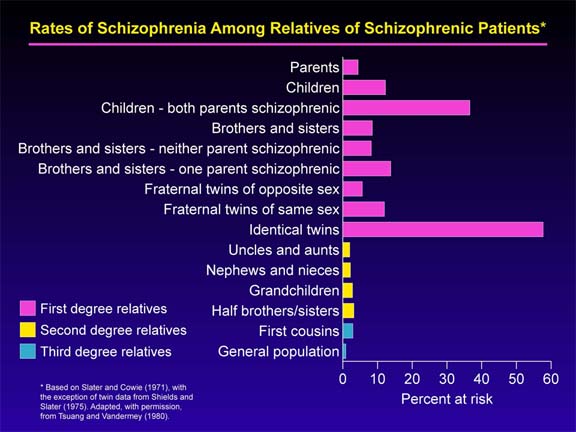
-Schizophrenia definitely has a very significant genetic component. Those who have a third degree relative with schizophrenia are twice as likely to develop schizophrenia as those in the general population. Those with a second degree relative have a several-fold higher incidence of schizophrenia than the general population, and first degree relatives have an incidence of schizophrenia an order of magnitude higher than the general populace. It is of much interest, though, that the correlation of schizophrenia between identical twins, who have identical genomes, is less than one-half. This indicates that schizophrenia is NOT entirely a genetic disease. Source


Other Things to Consider When Adopting:
-Having mental illness does not mean your life is over. Many people comply with treatment and live healthy, functional lives.
-Like stated above multiple times, genetic predisposition alone is often not enough to trigger illness. Although this is strictly anecdotal, my experience with folks who with are acutely ill and are in a state of very poor functioning is that the majority have a great deal of trauma and dysfunction in their past (abuse, very stressful family dynamics) and many are co-occuring meaning they use substances (although it's a chicken or egg question- did they use to self-medicate for symptoms they already had? or did their use trigger symptoms?). I think in making your decision, you can't look at just statistics alone, you must look at the environment you hope to provide. Stable environment doesn't guarantee anything but it negates risk.
-Consider the accuracy of self-report. The majority of information provided to adoption agencies from expectant parents is self-reported (possibly for themselves, most likely for the rest of their family). I am not saying the expectant parents "trick" the adoption agency, but it is very common for people to assign themselves diagnoses they have heard about or that a practitioner may have casually mentioned as a possibility (or as a soapbox, as a PCP may have decided to treat although they should really reserve for a mental health professional- just because you can doesn't mean you should... stepping off soapbox). How many people have mood swings and say they are bipolar or have a short attention span and say they are ADHD or are a perfectionist and say they are OCD?
-Questions to ask the agency when there is a family history of an illness: Who made the diagnoses and when? How does the illness affect their functioning- on disability? attempt suicide? frequently hospitalized?  Information like this may give you a better picture of what is really happening.
-Ultimately, you have to do what you feel comfortable with and equipped to handle. Talk with friends and family who you trust. Schedule a meeting with a doctor or mental health professional to discuss your concerns. Examine what support and resources are in your community if your child were to develop a chronic mental illness (eg: if you live in a very rural area, there are probably few resources).