


Note: While I don't agree with everything in this article, I think it has a lot of prudent points to approach parenting.
Have you noticed all the stressed
babies? Maybe one in 30 I see has glowing eyes, a sign of thriving.
What's up? Perhaps ignorance about babies and their needs. Here are 10
things to know.
1. Babies are social mammals with social mammalian needs. Social mammals emerged more than 30 million years ago with intensive parenting (the developmental nest or niche). This is one of the many (extra-genetic) things that evolved other than genes.
This developmental nest is required for an individual to develop
properly. Intensive parenting practices include years of breastfeeding
to develop brain
and body systems, nearly constant touch and physical presence of
caregivers, responsiveness to needs without distress, free play with
multi-aged playmates, and soothing perinatal experiences. Each of these
has significant effects on physical health.
2. Human babies are born "half-baked" and require an external womb.
Humans are born way early compared to other animals: 9 months early in
terms of mobility and 18 months early in terms of bone development and
foraging capacities. Full-term babies have 25% of adult brain volume and
most of it grows in the first 5 years. Thus, the human nest for its
young evolved to be even more intense than for other social mammals
because of the underdeveloped newborn, lasting for 3-5 years. Humans
also added to the list of expected care a village of positive social
support for both mother and baby. Actually, human brain development
lasts into the third decade of life, suggesting that social support and
mentoring continue at least that long.
3. If adults mess up on the post-birth “baking,” longterm problems can result. Each of the caregiving
practices mentioned above has longterm effects on the physical health
but also social health of the individual. For example, distressing
babies regularly or intensively (by not giving them what they need)
undermines self-regulatory systems. This is common knowledge in other
cultures and was so in our past. In Spanish, there is a term used for
adolescents and adults who misbehave: malcriado (misraised).
4. Babies thrive on affectionate love.
When babies receive food and diaper changes and little else, they die.
If they receive partial attention and stay alive, it is still not
enough--they won’t reach their full potential. Urie Bronfenbrenner, who
emphasized the multiple systems of support that foster optimal
development, said that babies do best when at least one person is crazy
about them. Others have noted that children grow best with three
affectionate, consistent caregivers. In fact, babies expect more than
mom and dad for loving care. Babies are ready for a community of close,
responsive caregivers that includes mother nearby.
5. Babies’ right hemisphere of the brain is developing rapidly in the first three years. The
right hemisphere develops in response to face-to-face social
experience, with extended shared eye gaze. The right hemisphere governs
self-regulatory systems. If babies are placed in front of screens,
ignored or isolated, they are missing critical experiences.
6. Babies expect to play and move.
Babies expect to be “in arms” or on the body of the caregiver most of
the time. Skin-to-skin contact is a calming influence. After learning
this one of my students when at a family gathering took a crying baby
and held it to his neck, which calmed it down. Babies expect
companionship not isolation or intrusion. They expect to be in the
middle of community social life.They are ready to play from birth. Play is a primary method for learning self-control and social skills. Companionship care—friendship, mutual responsiveness and playfulness—builds social and practical intelligence.
Babies and caregivers share intersubjective states, building the
child’s capacities for the interpersonal “dances” that fill social life.
7. Babies have built-in warning systems.
If they are not getting what they need, babies let you know. It is
best, as most cultures have long known, to respond to a baby’s grimace
or gesture and not to wait till crying occurs. Young babies have
difficulty stopping crying once it starts. The best advice for baby care
is to sensitively follow the baby, not the experts.
8. Babies lock their experiences into procedural memory vaults that will be inaccessible but apparent in later behavior and attitudes.
Babies can be traumatized from neglecting the list of needs above. They
won’t forget. It will undermine their trust of others, their health and
social wellbeing, and lead to self-centered morality which can do much destruction to the world.
9. Culture does not erase the evolved needs babies have.
Babies cannot retract their mammalian needs. Yet, some adult cultures
advocate violating baby needs as if they do not matter and despite the
protests of the baby. Everyday violations include baby isolation like sleeping
alone, “crying it out” sleep training, infant formula, or baby videos
and flashcards.* When violations occur regularly, at critical time
periods or are intense, they undermine optimal development. These
violations are encoded in the baby’s body as the optimal development of
systems is undermined (e.g., immunity, neurotransmitters, endocrine systems like oxytocin).
Surprisingly, some developmental psychologists think it fine to violate
these needs** in order for the child to fit into their culture.
The rationalization of “culture over biology” reflects a lack of understanding not only of human nature
but of optimal development. This has occurred in laboratories with
other animals whose natures were misunderstood. For example, Harry
Harlow, known for his experiments with monkeys and “mother love,” at
first did not realize he was raising abnormal monkeys when he isolated
them in cages. Similarly, at least one of the aggressive rat strains
used in lab studies today were first created when scientists isolated
offspring after birth, again not realizing the abnormality of isolation.
Note how the cultural assumptions of the scientists created the abnormal animals. So it matters what cultural assumptions you have.
The culture-over-biology view may be doing the same thing with human beings.
By not understanding babies and their needs, we are creating
species-atypical human beings. We can only know this to be the case in
light of knowledge about human beings who develop under evolved
conditions, with the evolved developmental nest: typically, small-band
hunter-gatherers. They are much wiser, perceptive and virtuous than we
humans in the USA today.
Thus the final point:
10. Experiences that consistently violate evolution undermine human nature. When
species-atypical childrearing occurs, we end up with people whose
health and sociality are compromised (which we can see all over the USA
today with epidemics of depression, anxiety, high suicide
and drug use rates***). Such mis-raised creatures might do all right on
achievement tests or IQ measures but they may also be dangerous
reptiles whose world revolves around themselves. A lot of smart reptiles
(“snakes in suits”) on Wall Street and elsewhere have been running the
country into the ground.
What to do?
(1) Inform others about the needs of babies.
(2) Be aware of the needs of babies around you and interact sensitively with the babies you encounter.
(3)
Support parents to be sensitive to the needs of their babies. This will
also require many more institutional and social supports for families
with children, including extensive parental leave which other developed
nations provide.
(4) Read books that convey the evolved principles of caregiving, like the following:
The Science of Parenting
Attached at the Heart
The Attachment Parenting Book
The Other Baby Book
Peaceful Parent, Happy Kids
The Science of Mother-Baby Sleep
* Note that sometimes violations (e.g., formula, isolation) are required under emergency conditions that are matters of life and death.
**Of course they don’t think it’s a violation because they don’t take the set of mammalian needs seriously.
***
In the USA, everyone under 50 has numerous health disadvantages
compared to citizens in 16 other developed nations (National Research
Council, 2013).
Source: Psychology Today
Showing posts with label education. Show all posts
Showing posts with label education. Show all posts
Monday, December 9, 2013

Thursday, November 14, 2013
Greatest Misconceptions About Adoption (repost)
There are lots of misconceptions out there about adoption, so here are a few discussed in another blog.
Wednesday, November 13, 2013

Tuesday, November 12, 2013
8 things to stop saying to your adoptive friends (repost)
I recently read a great post on rude things people say to adopting families along with suggestions on how to approach questions and things you wonder about an adoptive family. You can read it here.
Monday, November 11, 2013
More Positive Adoption Language

To me, this is one of the most important phrases in adoption. Except in rare cases where a baby is dropped at a safe haven, babies are not "given up" by their birth families (although even that is a loving choice when you compare the alternative of harming the baby or keeping the baby even if you know you cannot provide for its needs). Birth families anguish over adoption, and those who place deem it to be the best, most loving option for their specific situation.
Sunday, November 10, 2013
Nature v. Nurture
You can find varying opinions on "nature v. nurture" or "biology v. environment". I remember learning in child psychology class (in the opinion of my professor) that people's lives are roughly 75% environment, 25% biology. After working with multiple populations in child welfare and mental health, I'd tend to agree with that assessment. In general, an unstable, abusive, unpredictable, or neglectful environment tends to have poorer outcomes that can't be explained just from genetics. However, genetics are definitely a real factor in personality and health.
I found recent research findings that are interesting and wanted to share:
Researchers are making strides in understanding how genes work with the environment to shape behavior, adding a new twist to the age-old debate over whether nature or nurture is mostly responsible for how people develop.
They are finding that sensitivity to the environment resides in the biology of the nervous system. And some people, because of their genetic makeup and life experiences, are more sensitive to outside influences than others. Scientists point to a type they call orchids—people who wilt under poor conditions but flourish in supportive climes. Meanwhile, dandelions aren't much affected by the world around them, whether supportive or harsh.
Part of the difference stems from variation in genes like
DRD4, which helps regulate a chemical in the brain called dopamine, a
neurotransmitter that helps people experience pleasure and reward.
Evidence suggests that people who produce less dopamine—the
orchids—don't learn as well from negative feedback or in a distracting
environment, but do perform well in a warm but strict setting.
About 30% of Caucasians could be called orchids as a result of the genetic variation to DRD4, one review of research on the subject has shown. Prevalence in other ethnicities is less well known.
Researchers say the most startling discovery is that while sensitive orchids are hurt by bad outside influences, they can benefit profoundly from positive environments. Children who acted out more and did worse in school than classmates while coping with fighting parents, for example, shared more and performed better than peers after an intervention to promote a happier home life, according to a 2010 study of 338 children in the journal Child Development.
"The very characteristics that were often thought of as children's greatest frailties can also be their greatest strengths," says Bruce Ellis, a University of Arizona professor of family studies and human development who helped coin the orchid and dandelion designations and develop the theory.
The most recent study, published in August in the Proceedings of the National Academy of Sciences, looked at the impact of the economy on mothers' parenting.
The study found mothers with a particular genetic variation yelled, cursed and slapped their children more as the economy plunged during the recent downturn of 2008, though they parented less harshly than mothers who didn't have the genetic change as the economy improved in the early 2000s.
Mothers with the sensitive kind of gene do parenting "worse when conditions are deteriorating," says Irwin Garfinkel, a professor at Columbia University's School of Social Work who helped author the study. "But those with the sensitive gene do better when conditions are improving."
The findings that only certain people may be sensitive to outside influences have triggered a spirited debate about how best to help troubled youths and adults. Some say treatment might need to be different for those identified as orchids than those who are dandelions.
Much is still unknown about the mechanics behind people's environmental susceptibility. It is likely that most people aren't either an orchid or a dandelion, but have the qualities of each to varying degrees.
Critics like Glenn Roisman, a professor at the University of Minnesota's Institute of Child Development, question the strength of the evidence implicating particular genetic hitches in environmental sensitivity and say more rigorous study is needed.
Dr. Roisman says the research must better distinguish how good or how bad outside influences need to be to have a significant effect, and whether a person's susceptibility is specific to certain factors.
"If you're an orchid, you may be an orchid susceptible to specific environmental circumstances," such as parenting but not peer pressure, Dr. Roisman says.
Jay Belsky, a University of California, Davis, professor of human development, was among those who pioneered the idea that certain people are developmentally malleable.
Researchers had long thought that childhood experiences shaped how people turned out later in life. Dr. Belsky figured it made evolutionary sense that some children would be more susceptible to early influences than others because the future is uncertain.
If the future turned out as anticipated, these developmentally malleable children would be in a great position to flourish because they wound up fitting the environment in which they found themselves. But if the future was unexpected, these same kids would be mismatched, perhaps disastrously so.
To ensure survival over generations regardless of what the future brought, parents would have both orchid and dandelion offspring, Dr. Belsky thought.
Evidence hashing out the biology behind the theory and supporting its validity began pouring in about five years ago, once the technology for parsing genetic data was more widely available to researchers.
Researcher Marinus Van IJzendoorn and colleagues at Leiden University in the Netherlands took a sample of 157 children at risk for aggression and disobedience. They swabbed the inside of the study subjects' cheeks and analyzed the cells to see who had a variation of DRD4, the dopamine-regulating gene.
At a laboratory, Dr. Van IJzendoorn filmed the study subjects' mothers working with their at-risk children. Half of the parents in the study were visited six times by a social worker who reviewed the video and discussed how to be warmer while setting limits more strictly; the other parents didn't receive such training. The mothers answered questionnaires designed to assess the children's behavior.
"We found clear-cut evidence" that the children with the DRD4 variant "were more open to the changes in their parents' behavior: These children who showed most aggressive behavior without the parent training, displayed least problem behaviors after the training," Dr. Van IJzendoorn said in an email. The study was published in 2008 in the journal Developmental Psychology.
In 2011, Dr. Van IJzendoorn and colleagues published in the journal Development and Psychopathology an analysis of 15 studies involving more than 1,200 children confirming the hypothesis that dopamine-system related genes mark a person's susceptibility to the environment.
I found recent research findings that are interesting and wanted to share:
Researchers are making strides in understanding how genes work with the environment to shape behavior, adding a new twist to the age-old debate over whether nature or nurture is mostly responsible for how people develop.
They are finding that sensitivity to the environment resides in the biology of the nervous system. And some people, because of their genetic makeup and life experiences, are more sensitive to outside influences than others. Scientists point to a type they call orchids—people who wilt under poor conditions but flourish in supportive climes. Meanwhile, dandelions aren't much affected by the world around them, whether supportive or harsh.
Who Wilts, Who Flourishes
The interplay of the brain's biology and the environment makes some people more sensitive to outside influences than others, research shows. People more susceptible to external factors, both positive and negative, are called orchids. Others are hardy dandelions.
Orchids
- Prone to anxiety, depression, aggression in difficult conditions
- Trouble maintaining attention amid distractions
- Act out more when parents fight, but pay more attention in school when have happy home life
- Better students, more likely to share when praised
- Poverty, marital conflict, negativity speed up puberty
- Puberty starts later and progresses more slowly if higher quality relationship with parents
- Meditation likely to reduce stress levels dramatically

Dandelions
- Affected relatively little by adversity
- Can focus amid distractions
- Learning doesn't vary with home life
- Sharing doesn't improve more when praised
- Whatever the family life, puberty tends to proceed at about the same pace
- Meditation cuts stress levels, but not as much as in orchids
About 30% of Caucasians could be called orchids as a result of the genetic variation to DRD4, one review of research on the subject has shown. Prevalence in other ethnicities is less well known.
Researchers say the most startling discovery is that while sensitive orchids are hurt by bad outside influences, they can benefit profoundly from positive environments. Children who acted out more and did worse in school than classmates while coping with fighting parents, for example, shared more and performed better than peers after an intervention to promote a happier home life, according to a 2010 study of 338 children in the journal Child Development.
"The very characteristics that were often thought of as children's greatest frailties can also be their greatest strengths," says Bruce Ellis, a University of Arizona professor of family studies and human development who helped coin the orchid and dandelion designations and develop the theory.
The most recent study, published in August in the Proceedings of the National Academy of Sciences, looked at the impact of the economy on mothers' parenting.
The study found mothers with a particular genetic variation yelled, cursed and slapped their children more as the economy plunged during the recent downturn of 2008, though they parented less harshly than mothers who didn't have the genetic change as the economy improved in the early 2000s.
Mothers with the sensitive kind of gene do parenting "worse when conditions are deteriorating," says Irwin Garfinkel, a professor at Columbia University's School of Social Work who helped author the study. "But those with the sensitive gene do better when conditions are improving."
The findings that only certain people may be sensitive to outside influences have triggered a spirited debate about how best to help troubled youths and adults. Some say treatment might need to be different for those identified as orchids than those who are dandelions.
Much is still unknown about the mechanics behind people's environmental susceptibility. It is likely that most people aren't either an orchid or a dandelion, but have the qualities of each to varying degrees.
Critics like Glenn Roisman, a professor at the University of Minnesota's Institute of Child Development, question the strength of the evidence implicating particular genetic hitches in environmental sensitivity and say more rigorous study is needed.
Dr. Roisman says the research must better distinguish how good or how bad outside influences need to be to have a significant effect, and whether a person's susceptibility is specific to certain factors.
"If you're an orchid, you may be an orchid susceptible to specific environmental circumstances," such as parenting but not peer pressure, Dr. Roisman says.
Jay Belsky, a University of California, Davis, professor of human development, was among those who pioneered the idea that certain people are developmentally malleable.
Researchers had long thought that childhood experiences shaped how people turned out later in life. Dr. Belsky figured it made evolutionary sense that some children would be more susceptible to early influences than others because the future is uncertain.
If the future turned out as anticipated, these developmentally malleable children would be in a great position to flourish because they wound up fitting the environment in which they found themselves. But if the future was unexpected, these same kids would be mismatched, perhaps disastrously so.
To ensure survival over generations regardless of what the future brought, parents would have both orchid and dandelion offspring, Dr. Belsky thought.
Evidence hashing out the biology behind the theory and supporting its validity began pouring in about five years ago, once the technology for parsing genetic data was more widely available to researchers.
Researcher Marinus Van IJzendoorn and colleagues at Leiden University in the Netherlands took a sample of 157 children at risk for aggression and disobedience. They swabbed the inside of the study subjects' cheeks and analyzed the cells to see who had a variation of DRD4, the dopamine-regulating gene.
At a laboratory, Dr. Van IJzendoorn filmed the study subjects' mothers working with their at-risk children. Half of the parents in the study were visited six times by a social worker who reviewed the video and discussed how to be warmer while setting limits more strictly; the other parents didn't receive such training. The mothers answered questionnaires designed to assess the children's behavior.
"We found clear-cut evidence" that the children with the DRD4 variant "were more open to the changes in their parents' behavior: These children who showed most aggressive behavior without the parent training, displayed least problem behaviors after the training," Dr. Van IJzendoorn said in an email. The study was published in 2008 in the journal Developmental Psychology.
In 2011, Dr. Van IJzendoorn and colleagues published in the journal Development and Psychopathology an analysis of 15 studies involving more than 1,200 children confirming the hypothesis that dopamine-system related genes mark a person's susceptibility to the environment.
Saturday, November 9, 2013
Positive Adoption Language, Cont'd

The third entry I made when I started this blog was about positive adoption language. Using positive language takes some conscious thought, but if you make the effort to choose your words wisely, it will become a habit and it will show you value all members of the adoption triad.
Credit for this graphic is that I found it on Pinterest and links back to Attempting Agape.
Tuesday, November 5, 2013
Long Term Effects of Prenatal Substance Exposure
Go here to hear a free, one hour podcast on long term effects of prenatal substance exposure.
"Evaluating the risk of Prenatal Alcohol and Drug Exposure is one of the hardest decisions adoptive parents must make. Host Dawn Davenport interviewed Dr. Ira Chasnoff, one of the nation's leading researchers on long term effects of prenatal alcohol and drug exposure, and author of a new book on the subject- The Mystery of Risk. Dr. Chasnoff is President of the Children's Research Triangle and a Professor of Clinical Pediatrics at the University of Illinois College of Medicine in Chicago."
"Evaluating the risk of Prenatal Alcohol and Drug Exposure is one of the hardest decisions adoptive parents must make. Host Dawn Davenport interviewed Dr. Ira Chasnoff, one of the nation's leading researchers on long term effects of prenatal alcohol and drug exposure, and author of a new book on the subject- The Mystery of Risk. Dr. Chasnoff is President of the Children's Research Triangle and a Professor of Clinical Pediatrics at the University of Illinois College of Medicine in Chicago."
Sunday, November 3, 2013
FMLA & Adoption
If you qualify for FMLA (Family Medical Leave Act) through your employer, adoption must be covered the same as birth of a biological child. This is not legal advice but is a compilation of information I've gathered on the topic.
http://www.dol.gov/whd/regs/compliance/whdfs28B.pdf
http://www.dol.gov/whd/regs/compliance/whdfs28f.pdf
http://hrdailyadvisor.blr.com/2012/02/20/when-supervisors-often-make-an-fmla-mistake-adoption-and-foster-care/#
- To qualify for FMLA, you have to work for a private sector employer with 50+ employees or a public/government employer no matter the number of employees.
- To qualify for FMLA, you have to work at an employer for at least 12 months and have worked at least 1,250 hours in the preceding 12 month period.
- FMLA provides 12 weeks of leave for any adoption. This leave is NOT paid unless you have PTO to use during it or if your employer has some other paid benefit. This leave simply protects your job while you are off.
- This leave covers all types of adoption: domestic, international, and foster care (including placement for foster care, not necessarily just adoption from foster care).
- The time taken for FMLA must be taken within 12 months of placement.
- This time must taken as a continuous block of leave unless employer agrees to intermittent leave (however, if the child has a serious medical need, intermittent leave must be allowed).
- This leave can include time spent for adoption travel, adoption meetings and appointments, and court.
- Some states offer additional FMLA benefits in addition to the federal requirement of 12 months, so check to see what your state offers. For example, my state offers an additional 4 weeks for a total of 16 weeks for adoption and/or childbirth.
http://www.dol.gov/whd/regs/compliance/whdfs28B.pdf
http://www.dol.gov/whd/regs/compliance/whdfs28f.pdf
http://hrdailyadvisor.blr.com/2012/02/20/when-supervisors-often-make-an-fmla-mistake-adoption-and-foster-care/#
Saturday, November 2, 2013
Communicable Diseases in Pregnancy & Adoption
Note: As I wrote on the drug exposure post, I don't post this to perpetuate any stereotype of a birthmother necessarily having a communicable disease but to educate myself and others since some adoptive situations could involve medical risks and it is important to know risks and diagnostic information. Just wanted to make sure that is clear! :)
As part of the homestudy process, we had to specify if we are open to situations involving medical risks. I want to focus a post on several diagnoses that could be in consideration for an adoptive situation. This isn't substitute for professional medical advice but is a compilation of some research I've found.
Hepatitis
C
-“The
overall risk of transmitting hepatitis C to your baby while pregnant or during
birth is around 5% if you have
detectable levels of the virus in your blood” (Source).
-“There
is an increased risk of transmission from mother to baby when the mother is in
the acute (newly acquired) stage of hepatitis C infection; is co-infected with
HIV; has ongoing injecting drug use risk behaviors” (Source).
-“All babies born to women with
hepatitis C will test antibody positive at birth because their mother’s antibodies
cross the placenta into their blood stream. Antibodies are like memory cells,
reminding the body that it has been infected with a virus or bacteria in the
past. These antibodies pass through the placenta to the baby during the
pregnancy; however they do not infect the baby with the virus. By around the
age of 18 months, around 92-95% of babies will have cleared their mother’s
antibodies and test negative for hepatitis C. Therefore antibody testing should
only be carried out after the child reaches 18 months of age” (Source).
-“If you are pregnant and have
hepatitis C, the chance of your baby being infected with hepatitis C is the
same whether your baby is born by vaginal delivery or c-section” (Source).
-Even if a child becomes infected, there is still chance for the rest of the household to remain disease free. “Household transmission of hepatitis C is
extremely rare. Fewer than 1 in 1,000 family members or close acquaintances
becomes infected each year through common, nonsexual contact with hepatitis
C-infected persons. There are many possible ways by which hepatitis C could
be passed from one person to another. Because the virus is carried in the
blood, it could be transmitted between household members if a mucous membrane
(for example, in an eye, the mouth, or the nose) were to come in contact with
blood or body fluids containing hepatitis C. Family members sometimes share
razors, toothbrushes, or toothpicks, perhaps unknowingly. If an item were
contaminated with hepatitis C-infected blood from one person, the virus could
be passed to a second person if it were to tear the lining of the mouth or
break through the skin. Although these sorts of possibilities are often
discussed as potential ways for hepatitis C to infect family members, such
events occur very rarely” (Source). -Hepatitis C is not necessarily a death sentence. “The stabilization of chronic Hepatitis C, as opposed to the escalation of liver disease, is the predominant determiner of an infected person’s prognosis. Getting tested and diagnosed is the single most important step towards Hepatitis C stabilization. Only upon being aware of one’s Hepatitis C status can someone start to make choices that will help stabilize or cure their condition. Recent advancements in Hepatitis C drugs can lead to a cure in up to three-quarters of infected people. For those who are not candidates or are not successful in eliminating a chronic case of Hepatitis C through pharmaceuticals, there are many approaches that help prevent liver disease progression, such as being completely abstinent from alcohol, eating a liver-friendly diet, maintaining an ideal body weight, getting regular physical activity, avoiding cigarettes and drugs, and relieving stress on a regular basis” (Source)
-5/2014 update: A new and reportedly very effective Hep C medication has been released (Source).
HIV
-“A baby can become infected with HIV in the womb, during delivery or while breast-feeding. If the mother does not receive treatment, 25 percent of babies born to women with HIV will be infected by the virus. With treatment that percentage can be reduced to less than 2 percent, according to the March of Dimes” (Source).
-The risk of prenatal HIV transmission is below 2 % if HIV drugs are taken correctly. “Studies show that treatment works best at preventing HIV in a baby if it is started before 28 weeks into pregnancy” (Source Source2).
-“Until you know that your baby is HIV-positive or HIV-negative, ask your pediatric HIV specialist if your baby might benefit from anti-HIV medicines. New research shows that putting a newborn on a 2- or 3-drug anti-HIV medicine plan cuts the infant's risk of HIV by 50 percent (compared to using one drug only)” (Source).
-“If
your child has HIV/AIDS, you can take comfort in knowing that there is hope for
your child's future. Eighty percent of infected children have a slow rate of
disease progression (that means it takes a long time before the disease gets
worse). With treatment, children with HIV survive for longer now. There are
many adults alive today who were infected with HIV from their mothers at birth
and have grown into adulthood. They have a good quality of life because of new
HIV drugs, better care, and fewer opportunistic infections” (Source).
-“HIV cannot be transmitted
through casual contact, such as hugging
and closed-mouth kissing. HIV also cannot be transmitted by items
such as dishes, drinking glasses, toilet seats, or door knobs shared with an
HIV-infected person” (Source)
Co-occuring
Hepatitis C and HIV
-“Women
infected with both HIV and hepatitis C have a higher risk of transmitting
hepatitis C to their baby (transmission rates of 16% have been recorded for
mothers co-infected with HIV and hepatitis) than women who are not co-infected”
(Source).
-In hepatitis
C positive/HIV-negative women, route of delivery does not influence vertical
transmission. In Hepatitis C/HIV-coinfected women, decisions regarding mode of
delivery should be based on HIV status (Source).
Syphilis
-“Congenital
syphilis is a severe, disabling, and often life-threatening infection seen in infants.
A pregnant mother who has syphilis can spread the disease through the placenta
to the unborn infant. Nearly half of all children infected with syphilis while
they are in the womb die shortly before or after birth” (Source).
-“About 50 percent of pregnant women with untreated early syphilis end up a baby who's infected. (That's compared to 1 to 2 percent of women who get treated.)"
-“Some babies infected with syphilis whose mothers are not treated in a timely fashion during pregnancy develop problems before birth that are visible on an ultrasound. These problems might include an overly large placenta, fluid in their abdomen and severe swelling, and an enlarged liver or spleen. An infected baby may have other abnormalities at birth, such as a skin rash and lesions around the mouth, genitals, and anus; abnormal nasal secretions; swollen lymph glands; pneumonia; and anemia. Most babies don't have these symptoms initially, but without treatment they develop some symptoms within the first month or two after birth. And whether or not there are obvious symptoms early on, if the disease isn't treated, babies born with syphilis may end up with more problems years later, such as bone and teeth deformities, vision and hearing loss, and other serious neurological problems. That's why it's critical for women to be tested and treated during pregnancy, and for any baby who may have syphilis at birth to be fully evaluated and treated as well.” (Source).
-“About 50 percent of pregnant women with untreated early syphilis end up a baby who's infected. (That's compared to 1 to 2 percent of women who get treated.)"
-“Some babies infected with syphilis whose mothers are not treated in a timely fashion during pregnancy develop problems before birth that are visible on an ultrasound. These problems might include an overly large placenta, fluid in their abdomen and severe swelling, and an enlarged liver or spleen. An infected baby may have other abnormalities at birth, such as a skin rash and lesions around the mouth, genitals, and anus; abnormal nasal secretions; swollen lymph glands; pneumonia; and anemia. Most babies don't have these symptoms initially, but without treatment they develop some symptoms within the first month or two after birth. And whether or not there are obvious symptoms early on, if the disease isn't treated, babies born with syphilis may end up with more problems years later, such as bone and teeth deformities, vision and hearing loss, and other serious neurological problems. That's why it's critical for women to be tested and treated during pregnancy, and for any baby who may have syphilis at birth to be fully evaluated and treated as well.” (Source).
Gonorrhea
-“Gonorrhea
is a common STD in the United States. Untreated gonococcal infection in
pregnancy has been linked to miscarriages, premature birth and low birth weight, premature rupture of the membranes
surrounding the baby in the uterus, and infection of the fluid that surrounds
the baby during pregnancy. Gonorrhea can also infect an infant during delivery
as the infant passes through the birth canal. If untreated, infants can develop
eye infections. Because gonorrhea can cause problems in both the mother and her
baby, it is important to accurately identify the infection, treat with
effective antibiotics, and closely follow up to make sure that the infection
has been cured” (Source).
-“If you have a gonorrhea infection when you go into labor, you can pass the bacteria to your baby. Gonorrhea in newborns most commonly affects the eyes, and babies may eventually go blind if left untreated. The U.S. Preventive Services Task Force strongly recommends – and most states require by law – that all babies be treated with medicated eye drops or ointments soon after birth as a preventive measure. If the mother is known to have gonorrhea or the baby has a gonorrheal eye infection, he'll be treated with systemic antibiotics as well” (Source).
-“If you have a gonorrhea infection when you go into labor, you can pass the bacteria to your baby. Gonorrhea in newborns most commonly affects the eyes, and babies may eventually go blind if left untreated. The U.S. Preventive Services Task Force strongly recommends – and most states require by law – that all babies be treated with medicated eye drops or ointments soon after birth as a preventive measure. If the mother is known to have gonorrhea or the baby has a gonorrheal eye infection, he'll be treated with systemic antibiotics as well” (Source).
Chlamydia
“Chlamydia
is the most common sexually transmitted bacterium in the United States.
Although the majority of chlamydial infections do not have symptoms, pregnant
women may have abnormal vaginal discharge, bleeding after sex, or
itching/burning with urination. Untreated chlamydial infection has been linked
to problems during pregnancy, including preterm labor, premature rupture of the membranes
surrounding the baby in the uterus, and low birth weight.
The newborn may also become infected during delivery as the baby passes through
the birth canal. Neonatal (newborn) infections lead primarily to eye and lung
infections. All pregnant women should be tested for chlamydia at their first
prenatal visit. Repeat testing in the third trimester should be done for women
at high risk (Source).
Saturday, August 3, 2013
Genes, Mental Illness, & Adoption
Under normal circumstances, once one conceives a child, they pray for 9 months that the child is healthy and happy. There are no guarantees in life, but there is a definitive time frame for resolution (once you're pregnant... there's no going back) and fewer choices (usually you combine your and your partner's genetics and what happens, happens).
In adoption, you open yourself up to so much uncertainty. You have to make so many decisions. It's both an emotional and logical process to decide what situations you are comfortable with and how to proceed: what type of adoption? race? family history of mental illness, medical conditions, or intellectual disabilities? STDs in expectant mom? criminal history in family? conception through traumatic circumstances (sexual assault, incest)? when and what to tell child about adoption? what to tell others about child's history? how much contact to have with birthfamily after placement?
These are all things we discussed with our caseworker during the home study process and decisions we made. Obviously, it can't be decided lightly. I did a lot of research. One of the big decisions is how to proceed considering mental illness the in birth family.
In adoption, you open yourself up to so much uncertainty. You have to make so many decisions. It's both an emotional and logical process to decide what situations you are comfortable with and how to proceed: what type of adoption? race? family history of mental illness, medical conditions, or intellectual disabilities? STDs in expectant mom? criminal history in family? conception through traumatic circumstances (sexual assault, incest)? when and what to tell child about adoption? what to tell others about child's history? how much contact to have with birthfamily after placement?
These are all things we discussed with our caseworker during the home study process and decisions we made. Obviously, it can't be decided lightly. I did a lot of research. One of the big decisions is how to proceed considering mental illness the in birth family.
Genetics of mental illness is not a cut and dry science,
and research is always coming to new conclusions. I want to compile some facts
and considerations to hopefully help others who may be in the adoption research
process:
-Although the exact cause of most mental illnesses is not
known, it is becoming clear through research that many of these conditions are
caused by a combination of genetic, biological, psychological, and
environmental factors -- not personal weakness or a character defect -- and recovery
from a mental illness is not simply a matter of will and self-discipline.
Source
-Many mental illnesses run in families, suggesting they may
be passed on from parents to children through genes. Genes contain instructions
for the function of each cell in the body and are responsible for how we look,
act, think, etc. However, just because your mother or father may have or had a
mental illness doesn't mean you will have one. Hereditary just means that you
are more likely to get the condition than if you didn't have an affected family
member. Experts believe that many mental conditions are linked to problems in
multiple genes -- not just one, as with many diseases -- which is why a person
inherits a susceptibility to a mental disorder but doesn't always develop the
condition. The disorder itself occurs from the interaction of these genes and
other factors -- such as psychological trauma and environmental stressors --
which can influence, or trigger, the illness in a person who has inherited a
susceptibility to it. Source
-Researchers say there seem to be hundreds of genes involved
[in the development of mental illness]. Source The brain is the most complex
object of investigation in the history of biological science. Its development
depends on complex, often non-linear, gene–gene and gene-environment
interactions, as on stochastic processes associated with the interconnection of
100 000 million or more neurons. Source
-It is well established that the risk of mental illness runs
in families. Family, twin and adoption studies have shown that, for
schizophrenia, autism, manic depressive illness [bipolar disorder], major
depression, attention deficit hyperactivity disorder, panic disorder and other
mental illnesses, the transmission of risk is due to heredity. Source
Depression:
-Twin studies have recently concluded that the heritability
of depression is about 40 percent. This may sound fairly high, until you
realize that heritability refers only to an underlying risk of depression, not
to depression itself. Source
-Biology is not destiny: a child born of any parent
(depressed or not depressed), has about a 16.5 percent (one in six) chance of
experiencing a depressive episode during his or her lifetime. Source
-Depression is
not a single phenomenon, which makes it all the more difficult to figure out
the cause.
What’s clear is that for most people, depression appears to
be more a result of environment and experience than of one’s inherent nature,
which means that “upbringing,” to use an old-fashioned word, still matters. If
you do things halfway right and there are no unforeseen traumatic occurrences,
like crucial losses or undue stresses, chances are good — better than 50-50 —
that the child of a depressed parent will grow up to be a nondepressed
adult. Source
Bipolar disorder
-Studies report rates of bipolar disorder between 4% and 15%
in children with one bipolar parent, compared to 0% to 2% in the offspring of
parents who don't have the disorder. And if both parents are bipolar, rather
than just one, a child is about 3.5 times more likely to develop the condition.
Source
-Some hereditary factors are strong indicators of whether
someone will develop bipolar disorder or not. Identical twins have a 70 percent
higher chance of developing bipolar disorder. If one parent is bipolar, there
is a 7 to 10 percent higher risk of getting bipolar disorder. If there are two
parents, there is a 20 percent chance of developing bipolar in the offspring
because of the multiple genes. Source
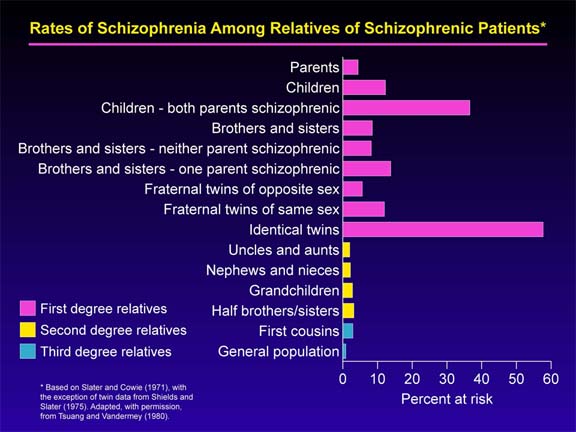
Schizophrenia
-Schizophrenia definitely has a very significant genetic
component. Those who have a third degree relative with schizophrenia are twice
as likely to develop schizophrenia as those in the general population. Those
with a second degree relative have a several-fold higher incidence of
schizophrenia than the general population, and first degree relatives have an
incidence of schizophrenia an order of magnitude higher than the general
populace. It is of much interest, though, that the correlation of schizophrenia
between identical twins, who have identical genomes, is less than one-half.
This indicates that schizophrenia is NOT entirely a genetic disease. Source
Other Things to Consider When Adopting:
-Having mental illness does not mean your life is over. Many people comply with treatment and live healthy, functional lives.
-Like stated above multiple times, genetic predisposition alone is often not enough to trigger illness. Although this is strictly anecdotal, my experience with folks who with are acutely ill and are in a state of very poor functioning is that the majority have a great deal of trauma and dysfunction in their past (abuse, very stressful family dynamics) and many are co-occuring meaning they use substances (although it's a chicken or egg question- did they use to self-medicate for symptoms they already had? or did their use trigger symptoms?). I think in making your decision, you can't look at just statistics alone, you must look at the environment you hope to provide. Stable environment doesn't guarantee anything but it negates risk.
-Consider the accuracy of self-report. The majority of information provided to adoption agencies from expectant parents is self-reported (possibly for themselves, most likely for the rest of their family). I am not saying the expectant parents "trick" the adoption agency, but it is very common for people to assign themselves diagnoses they have heard about or that a practitioner may have casually mentioned as a possibility (or as a soapbox, as a PCP may have decided to treat although they should really reserve for a mental health professional- just because you can doesn't mean you should... stepping off soapbox). How many people have mood swings and say they are bipolar or have a short attention span and say they are ADHD or are a perfectionist and say they are OCD?
-Questions to ask the agency when there is a family history of an illness: Who made the diagnoses and when? How does the illness affect their functioning- on disability? attempt suicide? frequently hospitalized? Information like this may give you a better picture of what is really happening.
-Ultimately, you have to do what you feel comfortable with and equipped to handle. Talk with friends and family who you trust. Schedule a meeting with a doctor or mental health professional to discuss your concerns. Examine what support and resources are in your community if your child were to develop a chronic mental illness (eg: if you live in a very rural area, there are probably few resources).
Sunday, June 23, 2013
Supporting and Understanding the Adoptive Family
Note: Some of these apply more to foster-adopt or international adoption situations (in regards to attachment/feeding/touching and past trauma). However, many apply to domestic infant adoption as well. I hope this will be educational and insightful for everyone, whether it is in regard to our future adoption, or to the adoption of someone else you know. :)
By Ashlee
Source: http://www.rainbowkids.com/ArticleDetails.aspx?id=801
Our children are not necessarily grateful to have been adopted.
And we don't expect them to be. It is not that our kids don't notice the stability of a family. It's not that they don't cherish the love that they are receiving or that they don't like their new life. It is because children are programmed to need, want and expect love. When we provide it we are not heroes, we are simply meeting one of their very basic needs. Expecting adopted children to be grateful for being adopted is like expecting our biological children to be grateful for being conceived. It was a choice that we, their parents, made and that they were brought into.
Please don't feed my kids.
For children who have known hunger, food means love. We want them to learn to love us, their parents and siblings, before they bond with extended family, neighbors and friends. I know that they stare longingly at anything edible. I know that our two year old puts his head on the table and looks at you with puppy dog eyes. But since we were not there to meet their early needs (breast or bottle feeding, comforting them when they were sick, changing diapers, kissing boo boos) we need to make up for it by meeting as many of their physical and emotional needs as possible now. Many adopted children also have food insecurities. Some eat until they vomit and then start eating again. Others hoard food, needing the comfort of knowing that there is some saved for later. It is best to leave all feeding to the parents unless specifically directed otherwise.
Parenting an adopted child is hard work and we struggle. We may tell you that were okay when we're really falling apart. We're worried that if we are honest about how difficult it is that you won't understand and that you'll think we're nuts. Adding a child who may or may not have anything in common with us socially, culturally, biologically or even personality-wise is challenging. Though undoubtedly beautiful and worth all of the struggles, adoption certainly isn't always easy or pretty.
It is greatly appreciated if you choose your wording carefully, especially around our children.
Yes, these are all our "real" kids (though sometimes it would be nice if all of my kids, adopted and biological, had "off" switches) and, in most situations, you probably do not need to specify whether you are talking about my "adopted kids" or my "biological kids". They are all my kids even if they joined us through different paths.
If you'd like to offer support (meal, help with house cleaning, etc) when an adopted child joins the family, please do even if we don't reach out and ask.
Many of us won't specifically ask for help or tell you what we need. However, I don't know a single adoptive mom who would turn down an offer to have a group of friends tidy/clean her house during those first few weeks at home with a new child. Likewise, coffee and chocolate are most always welcome and might be exactly what a new adoptive mom needs to get through those challenging times of adjustment!
Please don't try to get our child to like you the most.
Attachment and bonding are challenging enough without having friends and family slip our children candy, shower them with gifts, offer seconds at meals or encouraging bending and stretching of family rules. We're already working our tails off to get them to like us. With consistency and time they will learn to like you too, I promise.
Our adopted children had lives before they joined our family.
They had/have birth families and other relatives who are important to them and who deserve recognition and credit too. They have had life experiences that, while sometimes different than ours, are still special and valuable.
Be considerate of the types of questions that you ask about our child's background and personal history, especially in their presence and especially if they are old enough to understand.
Would it offend you if someone asked if you have AIDS, if you were abandoned, if your parents were drug users or how your parents died? If so, best not to ask these questions to someone else. We understand that it is normal to be curious and to wonder about the circumstances that led to a child's adoption. However, these are things that we discuss openly in our immediate family but not elsewhere. Our children may or may not choose to divulge more of their personal stories someday when they are older but they are THEIR stories and details to share, not mine.
Sometimes adopted children need to be parented differently than biological children.
We are not spoiling them. We aren't making excuses for poor behavior. Rather, we are parenting a child whose background may be very dissimilar to anything we've experienced. A child who has been abandoned and who has a fear of abandonment shouldn't be sent to time out alone in another room. A child who is still attaching to their adoptive family may need to be firmly held while having loving, affirming words whispered into their ear during a full-blown tantrum. The types of consequences that work for other children might not work for a child who doesn't have the same sense of value of their possessions and who doesn't understand what it means to have privileges. As parents, we must be flexible to help meet the individual needs of our child even if it means that we do things a little differently sometimes.
If you would like to give a gift to our new child, please consider something small that the whole family can enjoy together.
A few ideas are a frozen meal, a gift card to the movies, a small ornament commemorating the adoption or art supplies for all of the kids to share. We know that you want to welcome our new additions but gifts can be overwhelming for children who have had few material possessions. Also, we want our children to learn to love you for who you are, not for the fact that they hope they'll get another gift the next time they see you again. Other siblings may also experience jealousy and resentment if the new addition suddenly receives an armory of gifts and they are excluded.
Attachment takes time and work.
It doesn't happen overnight. Even if it appears that our child is securely attached to us it may take many months or years and every child and every family bonds differently. Many times we're faking it until we make it but one day we will wake up and realize that we're not faking it anymore and that our love is deep and real.
Parents who have recently added a child through adoption need support, friendship, love and encouragement.
Even if we're somewhat withdrawn and spending a lot of time at home cocooning with our new addition we value our friendships. Please continue to check up on us and to email, text, call or stop by. If you were in our life before we still want you in our life and in the lives of our children!
Please refrain from commenting on our child's appearance (specifically relating to ethnicity/race) in front of him or her.
All children want to feel included and to fit in. Pointing out how dark they are, how differently they look from the rest of us or how unique their hair feels only makes them feel like they stand out more.
Please do not ask adopted children if they like their new parents/family.
Adopted children do not usually get to hand pick their family. Adoption is similar to an arranged marriage and unique, sometimes very different people are brought together. With hard work and patience true love may grow. However, ask ANY child, biological or adopted (especially any older child!) if they like their parents and be prepared for some interesting answers!
It takes time to help children start to heal from a difficult past.
Just because they have been with us for a certain amount of time does not mean that the are "fixed". On the other hand, just because children are adopted does not necessarily mean that they will be any more difficult, defiant, less successful or anything else as teenagers or adults.
Educating your children about adoption and diversity helps my children. Talking openly about adoption, children who look different than one or both parents and other "nontraditional" family structures helps our children feel accepted and secure at extracurricular activities, church, school and elsewhere in our community.
Our new additions are not celebrities.
We appreciate all of the love and support that we were shown during our adoption process and we know that everyone is excited to meet them. However, taking photos of just our adopted child or pouring attention on them while ignoring our other children is not healthy for anyone. The child who is receiving all of the attention often feels singled out and siblings quickly become resentful.
Our children may be "delayed" when they join our family but often they just need time.
Adopted children are placed into environments that may be very different than anything they've ever experienced. They may be overstimulated, confused and sometimes there are language barriers. With time and patience most emotional, intellectual and physical delays will be overcome.
Please do not tell us how amazing we (parents) are because we have chosen to adopt. We know that this comment is usually intended as a compliment but our adopted kids are not burdens, charity cases or a community service project to be completed. As parents we gladly invest the time and energy needed to ensure the happiness and well-being of any of our children.
We may discourage physical contact with our child for the first several months that they are home or until we feel like they are securely attached to us.
Please do not insist on holding them, hugging them or having them sit on your lap. Many children who have lived in orphanages and institutions learn to fight for adult attention. Often they can put on quite the show and act like the most friendly, charming child to draw attention to themselves. While it may be cute and though it gives the false impression that they are well-adjusted and confident, it is very important that initially the parents are the only adults who help fulfill these children's need for physical affection. This also teaches healthy boundaries and is a safety consideration since no child, adopted or biological, should feel obligated to have close physical contact with someone that they do not know well.
We do not advertise our child's "cost".
If you would like to know how expensive our adoption process was, please ask when our children are not present, call after our kids are in bed or send us an email. Most adoptive families are happy to share our experiences and to provide helpful information but we do not ever want our children to feel like they were bought or that they are commodities.
When the going gets tough please do not ask if we regret our decision to adopt or imply that "we asked for it".
Few people would tell a sleep-deprived mother of a colicky newborn "well, you asked for this" and it would be considered rude to ask a new mother if she regretted her decision to have a baby. Just because something is difficult does not mean that we regret it. There are bumps in the road of every journey.
Even the happiest of adoptions are a result of challenging or difficult circumstances. Though we like to think of adoption as a "happy ending", birth parents may have made difficult decisions, children may have faced losses and many lives were forever changed. Though most adopted children grow to be happy, well-adjusted adults and though most adoptive families are beautiful and full of love, it is important not to romanticize adoption.
And, most importantly:
No one is perfect.
If you slip and call our biological kids our "real" kids or if you've already asked "What happened to his mother?" we won't hold a grudge. We know that our family is different. We understand that it is impossible to be sensitive and politically correct in every situation all the time. These are ideas and suggestions, not commandments.
We appreciate that you care about our family. We cannot thank you enough for wanting to learn more about supporting and understanding the adoptive family and for helping make this transition as smooth as possible for all of us!
Subscribe to:
Posts (Atom)


