


In adoption, you open yourself up to so much uncertainty. You have to make so many decisions. It's both an emotional and logical process to decide what situations you are comfortable with and how to proceed: what type of adoption? race? family history of mental illness, medical conditions, or intellectual disabilities? STDs in expectant mom? criminal history in family? conception through traumatic circumstances (sexual assault, incest)? when and what to tell child about adoption? what to tell others about child's history? how much contact to have with birthfamily after placement?
These are all things we discussed with our caseworker during the home study process and decisions we made. Obviously, it can't be decided lightly. I did a lot of research. One of the big decisions is how to proceed considering mental illness the in birth family.
Genetics of mental illness is not a cut and dry science,
and research is always coming to new conclusions. I want to compile some facts
and considerations to hopefully help others who may be in the adoption research
process:
-Although the exact cause of most mental illnesses is not
known, it is becoming clear through research that many of these conditions are
caused by a combination of genetic, biological, psychological, and
environmental factors -- not personal weakness or a character defect -- and recovery
from a mental illness is not simply a matter of will and self-discipline.
Source
-Many mental illnesses run in families, suggesting they may
be passed on from parents to children through genes. Genes contain instructions
for the function of each cell in the body and are responsible for how we look,
act, think, etc. However, just because your mother or father may have or had a
mental illness doesn't mean you will have one. Hereditary just means that you
are more likely to get the condition than if you didn't have an affected family
member. Experts believe that many mental conditions are linked to problems in
multiple genes -- not just one, as with many diseases -- which is why a person
inherits a susceptibility to a mental disorder but doesn't always develop the
condition. The disorder itself occurs from the interaction of these genes and
other factors -- such as psychological trauma and environmental stressors --
which can influence, or trigger, the illness in a person who has inherited a
susceptibility to it. Source
-Researchers say there seem to be hundreds of genes involved
[in the development of mental illness]. Source The brain is the most complex
object of investigation in the history of biological science. Its development
depends on complex, often non-linear, gene–gene and gene-environment
interactions, as on stochastic processes associated with the interconnection of
100 000 million or more neurons. Source
-It is well established that the risk of mental illness runs
in families. Family, twin and adoption studies have shown that, for
schizophrenia, autism, manic depressive illness [bipolar disorder], major
depression, attention deficit hyperactivity disorder, panic disorder and other
mental illnesses, the transmission of risk is due to heredity. Source
Depression:
-Twin studies have recently concluded that the heritability
of depression is about 40 percent. This may sound fairly high, until you
realize that heritability refers only to an underlying risk of depression, not
to depression itself. Source
-Biology is not destiny: a child born of any parent
(depressed or not depressed), has about a 16.5 percent (one in six) chance of
experiencing a depressive episode during his or her lifetime. Source
-Depression is
not a single phenomenon, which makes it all the more difficult to figure out
the cause.
What’s clear is that for most people, depression appears to
be more a result of environment and experience than of one’s inherent nature,
which means that “upbringing,” to use an old-fashioned word, still matters. If
you do things halfway right and there are no unforeseen traumatic occurrences,
like crucial losses or undue stresses, chances are good — better than 50-50 —
that the child of a depressed parent will grow up to be a nondepressed
adult. Source
Bipolar disorder
-Studies report rates of bipolar disorder between 4% and 15%
in children with one bipolar parent, compared to 0% to 2% in the offspring of
parents who don't have the disorder. And if both parents are bipolar, rather
than just one, a child is about 3.5 times more likely to develop the condition.
Source
-Some hereditary factors are strong indicators of whether
someone will develop bipolar disorder or not. Identical twins have a 70 percent
higher chance of developing bipolar disorder. If one parent is bipolar, there
is a 7 to 10 percent higher risk of getting bipolar disorder. If there are two
parents, there is a 20 percent chance of developing bipolar in the offspring
because of the multiple genes. Source
Schizophrenia
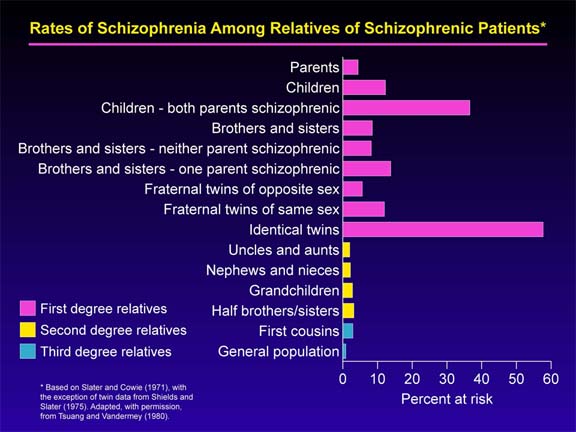
-Schizophrenia definitely has a very significant genetic
component. Those who have a third degree relative with schizophrenia are twice
as likely to develop schizophrenia as those in the general population. Those
with a second degree relative have a several-fold higher incidence of
schizophrenia than the general population, and first degree relatives have an
incidence of schizophrenia an order of magnitude higher than the general
populace. It is of much interest, though, that the correlation of schizophrenia
between identical twins, who have identical genomes, is less than one-half.
This indicates that schizophrenia is NOT entirely a genetic disease. Source
Other Things to Consider When Adopting:
-Having mental illness does not mean your life is over. Many people comply with treatment and live healthy, functional lives.
-Like stated above multiple times, genetic predisposition alone is often not enough to trigger illness. Although this is strictly anecdotal, my experience with folks who with are acutely ill and are in a state of very poor functioning is that the majority have a great deal of trauma and dysfunction in their past (abuse, very stressful family dynamics) and many are co-occuring meaning they use substances (although it's a chicken or egg question- did they use to self-medicate for symptoms they already had? or did their use trigger symptoms?). I think in making your decision, you can't look at just statistics alone, you must look at the environment you hope to provide. Stable environment doesn't guarantee anything but it negates risk.
-Consider the accuracy of self-report. The majority of information provided to adoption agencies from expectant parents is self-reported (possibly for themselves, most likely for the rest of their family). I am not saying the expectant parents "trick" the adoption agency, but it is very common for people to assign themselves diagnoses they have heard about or that a practitioner may have casually mentioned as a possibility (or as a soapbox, as a PCP may have decided to treat although they should really reserve for a mental health professional- just because you can doesn't mean you should... stepping off soapbox). How many people have mood swings and say they are bipolar or have a short attention span and say they are ADHD or are a perfectionist and say they are OCD?
-Questions to ask the agency when there is a family history of an illness: Who made the diagnoses and when? How does the illness affect their functioning- on disability? attempt suicide? frequently hospitalized? Information like this may give you a better picture of what is really happening.
-Ultimately, you have to do what you feel comfortable with and equipped to handle. Talk with friends and family who you trust. Schedule a meeting with a doctor or mental health professional to discuss your concerns. Examine what support and resources are in your community if your child were to develop a chronic mental illness (eg: if you live in a very rural area, there are probably few resources).


No comments:
Post a Comment