


Saturday, August 17, 2013

Friday, August 16, 2013
Wednesday, August 14, 2013
Psalm 13
1How long, Lord? Will you forget me forever?
How long will you hide your face from me?
2 How long must I wrestle with my thoughts
and day after day have sorrow in my heart?
How long will my enemy triumph over me?
3 Look on me and answer, Lord my God.
Give light to my eyes, or I will sleep in death,
4 and my enemy will say, “I have overcome him,”
and my foes will rejoice when I fall.
5 But I trust in your unfailing love;
my heart rejoices in your salvation.
6 I will sing the Lord’s praise,
for he has been good to me.
-Psalm 13
Saturday, August 3, 2013
Genes, Mental Illness, & Adoption
Under normal circumstances, once one conceives a child, they pray for 9 months that the child is healthy and happy. There are no guarantees in life, but there is a definitive time frame for resolution (once you're pregnant... there's no going back) and fewer choices (usually you combine your and your partner's genetics and what happens, happens).
In adoption, you open yourself up to so much uncertainty. You have to make so many decisions. It's both an emotional and logical process to decide what situations you are comfortable with and how to proceed: what type of adoption? race? family history of mental illness, medical conditions, or intellectual disabilities? STDs in expectant mom? criminal history in family? conception through traumatic circumstances (sexual assault, incest)? when and what to tell child about adoption? what to tell others about child's history? how much contact to have with birthfamily after placement?
These are all things we discussed with our caseworker during the home study process and decisions we made. Obviously, it can't be decided lightly. I did a lot of research. One of the big decisions is how to proceed considering mental illness the in birth family.
In adoption, you open yourself up to so much uncertainty. You have to make so many decisions. It's both an emotional and logical process to decide what situations you are comfortable with and how to proceed: what type of adoption? race? family history of mental illness, medical conditions, or intellectual disabilities? STDs in expectant mom? criminal history in family? conception through traumatic circumstances (sexual assault, incest)? when and what to tell child about adoption? what to tell others about child's history? how much contact to have with birthfamily after placement?
These are all things we discussed with our caseworker during the home study process and decisions we made. Obviously, it can't be decided lightly. I did a lot of research. One of the big decisions is how to proceed considering mental illness the in birth family.
Genetics of mental illness is not a cut and dry science,
and research is always coming to new conclusions. I want to compile some facts
and considerations to hopefully help others who may be in the adoption research
process:
-Although the exact cause of most mental illnesses is not
known, it is becoming clear through research that many of these conditions are
caused by a combination of genetic, biological, psychological, and
environmental factors -- not personal weakness or a character defect -- and recovery
from a mental illness is not simply a matter of will and self-discipline.
Source
-Many mental illnesses run in families, suggesting they may
be passed on from parents to children through genes. Genes contain instructions
for the function of each cell in the body and are responsible for how we look,
act, think, etc. However, just because your mother or father may have or had a
mental illness doesn't mean you will have one. Hereditary just means that you
are more likely to get the condition than if you didn't have an affected family
member. Experts believe that many mental conditions are linked to problems in
multiple genes -- not just one, as with many diseases -- which is why a person
inherits a susceptibility to a mental disorder but doesn't always develop the
condition. The disorder itself occurs from the interaction of these genes and
other factors -- such as psychological trauma and environmental stressors --
which can influence, or trigger, the illness in a person who has inherited a
susceptibility to it. Source
-Researchers say there seem to be hundreds of genes involved
[in the development of mental illness]. Source The brain is the most complex
object of investigation in the history of biological science. Its development
depends on complex, often non-linear, gene–gene and gene-environment
interactions, as on stochastic processes associated with the interconnection of
100 000 million or more neurons. Source
-It is well established that the risk of mental illness runs
in families. Family, twin and adoption studies have shown that, for
schizophrenia, autism, manic depressive illness [bipolar disorder], major
depression, attention deficit hyperactivity disorder, panic disorder and other
mental illnesses, the transmission of risk is due to heredity. Source
Depression:
-Twin studies have recently concluded that the heritability
of depression is about 40 percent. This may sound fairly high, until you
realize that heritability refers only to an underlying risk of depression, not
to depression itself. Source
-Biology is not destiny: a child born of any parent
(depressed or not depressed), has about a 16.5 percent (one in six) chance of
experiencing a depressive episode during his or her lifetime. Source
-Depression is
not a single phenomenon, which makes it all the more difficult to figure out
the cause.
What’s clear is that for most people, depression appears to
be more a result of environment and experience than of one’s inherent nature,
which means that “upbringing,” to use an old-fashioned word, still matters. If
you do things halfway right and there are no unforeseen traumatic occurrences,
like crucial losses or undue stresses, chances are good — better than 50-50 —
that the child of a depressed parent will grow up to be a nondepressed
adult. Source
Bipolar disorder
-Studies report rates of bipolar disorder between 4% and 15%
in children with one bipolar parent, compared to 0% to 2% in the offspring of
parents who don't have the disorder. And if both parents are bipolar, rather
than just one, a child is about 3.5 times more likely to develop the condition.
Source
-Some hereditary factors are strong indicators of whether
someone will develop bipolar disorder or not. Identical twins have a 70 percent
higher chance of developing bipolar disorder. If one parent is bipolar, there
is a 7 to 10 percent higher risk of getting bipolar disorder. If there are two
parents, there is a 20 percent chance of developing bipolar in the offspring
because of the multiple genes. Source
Schizophrenia
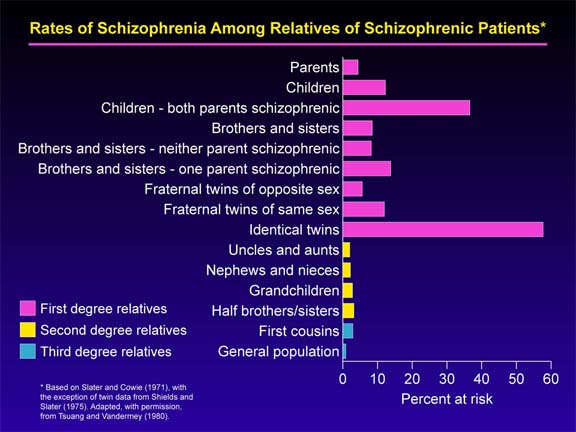
-Schizophrenia definitely has a very significant genetic
component. Those who have a third degree relative with schizophrenia are twice
as likely to develop schizophrenia as those in the general population. Those
with a second degree relative have a several-fold higher incidence of
schizophrenia than the general population, and first degree relatives have an
incidence of schizophrenia an order of magnitude higher than the general
populace. It is of much interest, though, that the correlation of schizophrenia
between identical twins, who have identical genomes, is less than one-half.
This indicates that schizophrenia is NOT entirely a genetic disease. Source
Other Things to Consider When Adopting:
-Having mental illness does not mean your life is over. Many people comply with treatment and live healthy, functional lives.
-Like stated above multiple times, genetic predisposition alone is often not enough to trigger illness. Although this is strictly anecdotal, my experience with folks who with are acutely ill and are in a state of very poor functioning is that the majority have a great deal of trauma and dysfunction in their past (abuse, very stressful family dynamics) and many are co-occuring meaning they use substances (although it's a chicken or egg question- did they use to self-medicate for symptoms they already had? or did their use trigger symptoms?). I think in making your decision, you can't look at just statistics alone, you must look at the environment you hope to provide. Stable environment doesn't guarantee anything but it negates risk.
-Consider the accuracy of self-report. The majority of information provided to adoption agencies from expectant parents is self-reported (possibly for themselves, most likely for the rest of their family). I am not saying the expectant parents "trick" the adoption agency, but it is very common for people to assign themselves diagnoses they have heard about or that a practitioner may have casually mentioned as a possibility (or as a soapbox, as a PCP may have decided to treat although they should really reserve for a mental health professional- just because you can doesn't mean you should... stepping off soapbox). How many people have mood swings and say they are bipolar or have a short attention span and say they are ADHD or are a perfectionist and say they are OCD?
-Questions to ask the agency when there is a family history of an illness: Who made the diagnoses and when? How does the illness affect their functioning- on disability? attempt suicide? frequently hospitalized? Information like this may give you a better picture of what is really happening.
-Ultimately, you have to do what you feel comfortable with and equipped to handle. Talk with friends and family who you trust. Schedule a meeting with a doctor or mental health professional to discuss your concerns. Examine what support and resources are in your community if your child were to develop a chronic mental illness (eg: if you live in a very rural area, there are probably few resources).
Wednesday, July 31, 2013
Dreaming
We have been in the process to become parents for right at 2 years now. I never had a dream about being pregnant or giving birth to a biological child during the time of infertility treatments, never had a dream about being a foster parent when we had an home study with DCS, and so far have never had a dream about adopting a baby.
Now, I've had an ongoing dream for 10+ years of being responsible for a random baby and forgetting to feed it, but I think that's more indicative with my personality flaw known as anxiety (I am long out of college and still have ongoing dreams of forgetting to go to class and failing a semester). The point is, the baby in my dream has never been "mine". Other people I know have had dreams about me adopting or having my own children. But never me.
Last night I had a dream that we were at our agency and the staff was telling us how great our book was (lol) and how several people had considered matching with us, so they figured the time would be "any day now".
This is likely just my psyche's wishful thinking. Still, it is good to know my conscious and unconscious are finally connected and in agreement with adoption. It is easy to stay detached from an uncertain, stressful process, especially one that involves getting on my agency's portal to check messages and going to a once a month support group meeting rather than having an ultrasound or feeling a baby kick. I don't want to become overly invested in any situation early on (or before there is even a situation to speak of) but I also don't want to be detached and cold, either.
Monday, July 29, 2013


Sunday, July 28, 2013
Baby Veronica Update
Lawyers for the biological father of a Native American child are
expected to make a last-ditch appeal to the U.S. Supreme Court on
Thursday, hoping to prevent the return of the child to her adoptive
parents [this was filed according to CBS news].
But the four-year legal saga is likely near an end.
Eighteen months ago the South Carolina Supreme Court ordered 2-year-old "Baby Veronica" removed from her adoptive parents, Matt and Melanie Capobianco, and turned over to her biological father, Dusten Brown. The Capobiancos had adopted the child at birth, and provided what all agreed was a good home. The state court said it was acting reluctantly in transferring custody but was required to do so under a federal law aimed at keeping Native American families together.
In June, however, the U.S. Supreme Court ruled that since Brown, the biological father, had refused to provide financial support for the biological mother and child when told of the pregnancy — and because he had renounced his parental rights at that time — he could not later object to the adoption. The high court rejected Brown's argument that the Indian Child Welfare Act trumped state law in such circumstances.
The justices ordered the case remanded to the South Carolina Supreme Court, which in early July ordered the child returned to the adoptive parents. Brown then petitioned for rehearing, and at the same time initiated proceedings in the tribal court in Oklahoma, where he lives.
But on Wednesday, the South Carolina Supreme Court ordered the adoption finalized and told the family court to transfer custody of the child to the adoptive parents, using whatever transition plan is in the best interests of the child.
When Veronica was taken from the Capobiancos 18 months ago, there was no transition period, and she cried and screamed when taken away. The Capobiancos have proposed a one- to two-week transition in Oklahoma before taking full custody and have offered to let Brown visit his daughter in South Carolina.
Source: http://www.npr.org/2013/07/24/205224853/s-c-court-orders-baby-veronica-adoption-finalized
Subscribe to:
Posts (Atom)


